
Managing stress in rescue dogs can be extremely difficult, especially when you don’t know their previous experiences in life. Whether a dog has been rescued from a neglectful or abusive environment or is simply being rehomed through circumstances beyond a loving owner’s control, the adjustments are going to be stress-inducing. Understanding how their stress-levels fluctuate is a huge step towards helping your rescue dog cope with the changes in their life.
Cortisol – the “stress hormone”
Cortisol is a hormone produced by the adrenal glands that plays a key role in the body’s response to stress. Often called the “stress hormone,” cortisol helps regulate functions like metabolism, blood pressure, and the immune response. When our dogs face a stressful situation, their cortisol levels naturally rise to help them respond – boosting energy and alertness.
However, if stress becomes chronic, cortisol can remain elevated for long periods, which may lead to negative effects in the dog, such as anxiety, disinterest in food, crazy or odd behaviour, “bad behaviour” and, even weakened immunity. Recognising and understanding when your dog is experiencing chronic stress and overwhelm can make a tremendous difference to knowing how to support them and address this.
Crazy behaviour through stress or overwhelm is often mistaken for lack of exercise and stimulus. As a result, it is often wrongly addressed with more exercise and stimulus, rather than the much-needed rest and sleep the dog need, thus adding to the problem and exacerbating the behaviour over time.
The “Emotional Bucket”
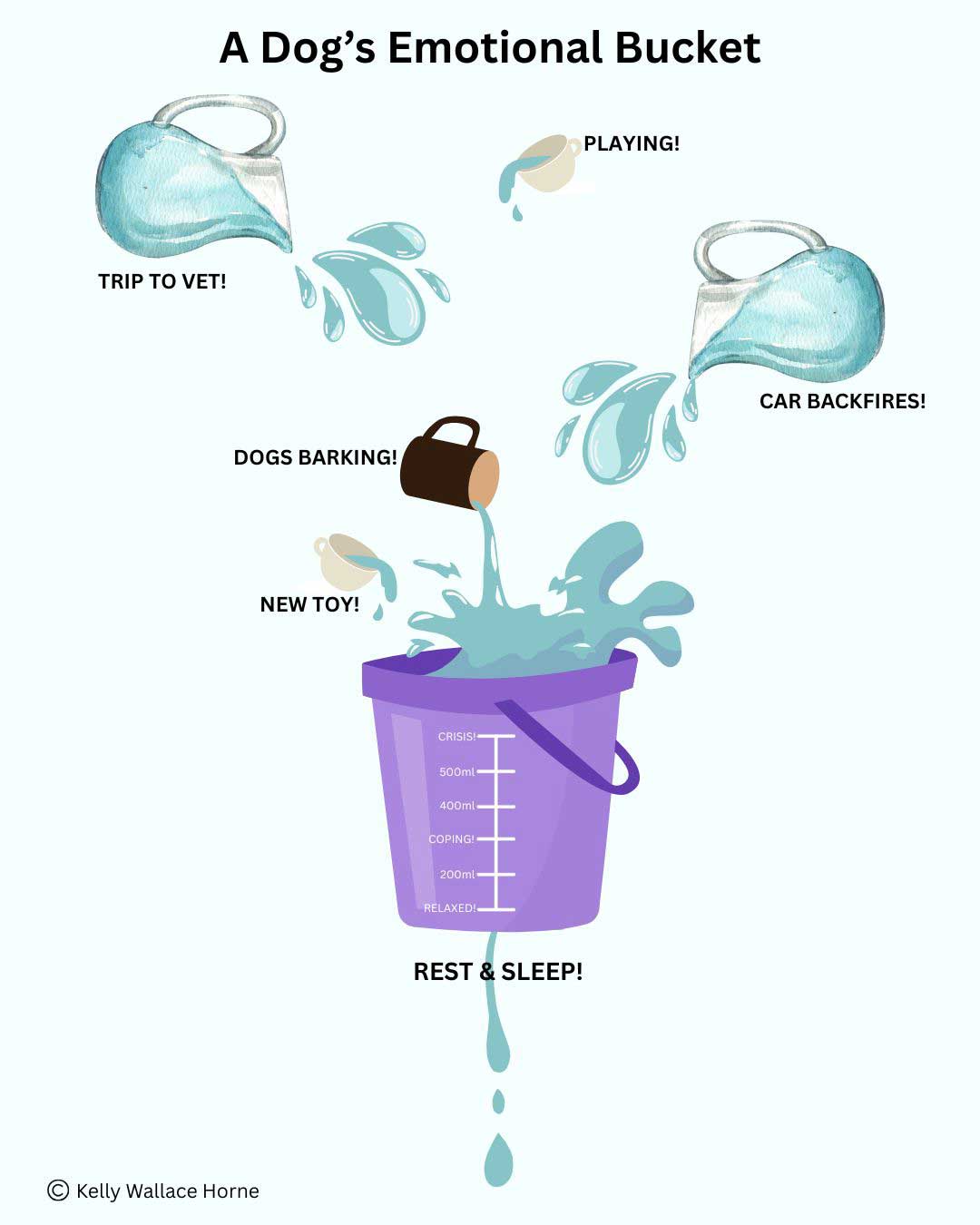
Probably the simplest way of understanding your dog’s behaviour and coping mechanism is to imagine an “emotional bucket”. The emotional bucket is a simple but powerful metaphor used to help understand how people – and dogs – handle their emotions.
Imagine that everything the dog does each day adds to their emotional bucket. Simple things add a tea-cup-full to it; exciting, negative, stressful, and frightening experiences add a jug-full to it.
Imagine the emotional bucket has a hole in the base, where the emotional bucket slowly empties as your dog rests and sleeps, and their cortisol levels decrease.
In a happy, secure dog, the better the balance between rest and sleep versus stimulus and stress, the better a dog will cope with the ups and downs of daily life. In the case of rescue dogs, the better they will cope with changes in their life and recover from any past trauma.
If a dog struggles to rest and sleep, or doesn’t get enough opportunity to do so, you can envisage the hole in their bucket being very small – their bucket will empty very slowly and so will fill very quickly.
A healthy adult dog can sleep anywhere between 12 and 18 hours a day, depending on age and activity levels. Puppies need between 18 and 20 hours of sleep each day.
Just like a real bucket, there is a limit to the capacity of their metaphorical bucket, and it eventually overflows, resulting in stress responses, and odd, crazy, and even aggressive behaviours. We’ve all, at some point, experienced stress and overwhelm to the extent that we feel fit to explode, often resulting in us behaving in ways that we wouldn’t ordinarily. Quite often that might be snapping at someone in the heat of the moment. Fundamentally, dogs are exactly the same!
Filling the emotional bucket
Everything that a dog experiences day-to-day adds to the contents of the bucket, including everyday things like;
- Going for a walk, or a run in the park
- Receiving a new toy
- Playing with humans or with another dog
- Having their nails trimmed
- Having their teeth cleaned
- A Vet trip
- Visitors coming to the home
- Going into town, or to a fete or dog show
Add to that exceptional experiences, for example;
- Fireworks, or a car backfiring
- Being barked at by another dog
- Being attacked or getting into a fight with another dog
- Going on holiday/away for the weekend
- Moving house
- Visitors staying at their home
- The arrival of a baby to their family
- Being rehomed with fosters and/or new owners
Studies have shown that in a dog frightened by gunshot or fireworks, it can take some 72 hours after the experience for their cortisol levels to return to normal levels. If further daily experiences add to that, it can be days or weeks that the dog’s cortisol levels remain unhealthily high.

Emptying the emotional bucket
The way to empty the emotional bucket is to;
- Limit adding to the emotional bucket
- Allow cortisol levels to drop with rest and relaxation
If you recognise that your dog is experiencing emotional overwhelm it is important to be mindful of everything that is adding to their emotional bucket and try, as much as possible, to limit adding to it.
Remember, positive and fun experiences also add to the emotional bucket, not just negative experiences!
- Sometimes dogs need a day or a few days off walking/going out. If a dog is experiencing stress while out on a walk, playing with you at home is likely to contribute less to the emotional bucket while still exercising and stimulating your dog.
- Sometimes dogs need enforced time out, where they are separated from other dogs/pets (if they are overstimulated or stressed by their companions), and from children and other interruptions/stimulus. Undisturbed sleep is an important factor in emptying their emotional bucket.
- Chewing is a very good, calming activity for dogs, and is proven to reduce stress. Long lasting chews (non-rawhide) like stuffed Kongs, pizzles, pigs ears, “moon bones” etc. can encourage chewing for longer periods. Again, separate your dogs if resource-guarding is an issue with their companions.
A common action that can contribute to stress in a newly rescued dog is touching or picking them up without warning, particularly when they are resting or sleeping. This can be very stressful, especially in nervous dogs or simply while the dog is adjusting to new people in their life. Speaking to the dog and alerting them to your intention to touch or pick them up can minimise the addition this action makes to their emotional bucket.
If you are experiencing challenging or concerning behaviours in a dog, consider keeping a diary of things the dog does and experiences each day, taking inspiration from the examples above. Then be mindful of the time they spend sleeping, resting, and chewing (without being hassled by anyone, human or animal!). This might help you to recognise how full their emotional bucket is, and how much opportunity it has versus needs to be able to empty. You will often be surprised at how much better they behave and cope with change (and even life in general) when the balance is right!
By Kelly Wallace Horne
About the Author
I have two Italian Greyhounds, Chico and Pasha. I enjoy training my own Italian Greyhounds in obedience, participating in agility, hoopers, and dabbling in scent work, as well as breed showing. I am a certified Pro Dog Trainer and a member of the International Institution of Canine Ethics. I love studying and learning and have gained a variety of diplomas, advanced diplomas, and accreditations in canine behaviour, nutrition, physiology, canine holistic care, canine law, as well as wolf behaviour and how it correlates with domestic dog behaviour.
The content provided in this article is for informational purposes only. It is the responsibility of the individual to ensure that the information they are working to is correct and appropriate for their specific circumstances.
© Kelly Wallace Horne. Unauthorised use and/or duplication of this material without express and written permission from the author and/or the Italian Greyhound Rescue Charity is strictly prohibited. Excerpts and links may be used, provided that full and clear credit is given to Kelly Wallace Horne and The Italian Greyhound Rescue Charity with appropriate and specific direction to the original content.
You must be logged in to post a comment.